Saturday, August 09, 2008

Debt Relief Solutions

Plenty of consumers are currently facing a crisis with the debt they acquired before the recession took hold of the American economy. By now we're all too familiar with the much-discussed collapse of home values and the seemingly limitless supply of foreclosures that continue to flood the market. But the national problem with unsecured debt, typically in the form of high-interest credit card debt, threatens to become an issue of comparable significance as consumers scramble to find an appropriate solution. If this situation describes the task you now face, then take heart. The good news is that there are solutions available, and that there is one that is likely to suit your circumstances better than the others. Each has its own set of benefits and shortcomings, and it is imperative for the consumer to collect enough information to make the proper choice of a solution. Sadly, many consumers have compounded their financial predicaments by choosing a solution that was a poor fit for their particular situation. Before you move forward with any solution, make sure that you understand the options you have and why it is that the one you choose makes the most sense for you.

There are 5 main categories of debt relief solutions from which to choose. They are listed here in the order of the severity of the debt problem, from the least severe to the most:
  1. Thrift and Discipline - reduce expenses where possible and try to increase income. This solution may be sufficient in and of itself for less severe debt problems, and it can also be used in conjunction with the other 4 solutions to enhance their effectiveness.

  2. Debt Consolidation - do a cash-out refinance of your home or take out a HELOC to pay off the high-interest debt. Unfortunately this solution is very difficult to implement due to the loss of equity most homeowners have experienced. Tight lending guidelines now predominate in the lending industry.

  3. Credit Counseling - also known as debt management, consumers can enroll in a debt management plan (DMP) to reduce interest rates, stop over-limit and late fees, have a consolidated monthly payment, get relief from collection phone calls, and become debt-free in 5 years or less.

  4. Debt Settlement - also reduce their debt amount. There has been a high level of consumer complaints, however, as there are major shortcomings that can jeopardize the success of the program.

  5. Bankruptcy - a "fresh start" Chapter 7 or a Chapter 13 repayment plan are available, but a new 2-part "means test" for Chapter 7 that was instituted in 2005 effectively disqualifies many filers and forces them into Chapter 13 instead. The consequences for the consumer's credit are severe, lasting from 7 to 10 years.


Thrift and discipline are typically sufficient remedies for those with relatively minor financial problems. Debt consolidation is a risky proposition if it can even be done, due primarily to the exchanging of unsecured debt for secured debt. In doing so, the consumer places his home at risk, not just his credit. Credit counseling offers a broad range of benefits for those plagued by high interest rates, and a significant advantage it holds over debt settlement and bankruptcy is the fact that the consumer's credit score is unaffected by enrollment in a DMP. Debt settlement is a riskier proposition that has the potential to offer greater benefits than credit counseling, but at a cost: significant credit score damage and a more stressful consumer experience. Bankruptcy is usually the option of last resort, and the credit damage that results makes it an extremely difficult choice.

Friday, November 09, 2007

Review of NationalPayday.com

Payday loans fill an important void that is not served by traditional banks. In a perfect world, everyone would be on top of his or her finances, and there wouldn't be a need for payday lenders. But in reality, most of us have gotten behind on bills at some point.

National Payday offers cash advance loans based on your next paycheck. A payday loan is something to consider if you find yourself in a short-term bind and in need of money. As an example, if you have been shopping for one too many "bargains", and can't make your credit card payment, a payday loan may help you out. Applying for a payday loan is simple, and takes only a few minutes to complete. Most loans are approved within 24 hours.

National Payday has a FAQ that explains how to apply for a loan. A checking account and a steady job are the requirements to apply. To explain how the loan works, suppose you were to borrow $300 from the payday lender. The lender then transfers this money to your checking account, and expects you to pay this amount plus a 25% fee ($75 on a $300 loan) when you receive your next paycheck.

I advise borrowers to read National Payday's disclosure information before applying for a loan. The effective annual percentage rate (APR) on the loan can be several hundred percent, depending on the situation. If used correctly, a payday loan can help tide you over to the next payday.

This post is sponsored by National Payday.

Monday, April 03, 2006

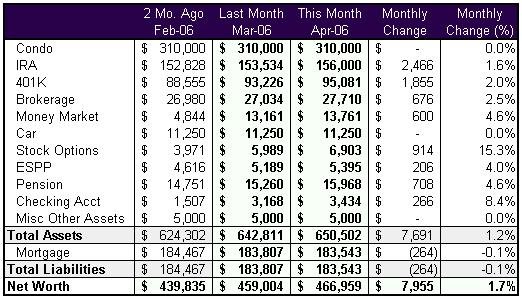
April Net Worth $466,959 (up $7,955)


My April has a strong showing at $466,959, up nearly $8,000 over March. Most notable are investment gains in my IRA and 401(k) accounts. I also had additional stock options vest which resulted in nice gains there.